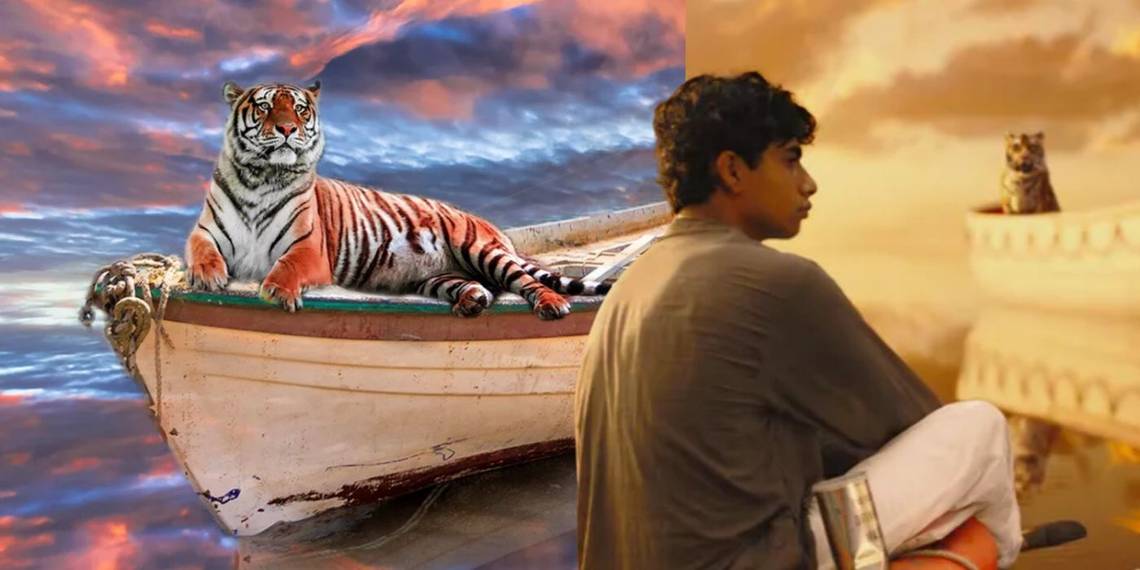
Ang Lee’s Life of Pi is racking-up critical acclaim (read our review) and pre-award season buzz along with solid box office numbers. Though, for every mention of the film’s beautiful 3D or amazing CGI tiger, there’s a fuddled viewer confused by the movie’s controversial ending.
Readers of Yann Martel’s original novel (the ones who made it to the end) have already faced the challenging last-minute question presented by the story’s narrator, but filmgoers expecting a fanciful adventure at sea have been understandably caught off-guard by the finale. No doubt, viewers will debate the ending with friends and family – but to help steer discussion we’ve put together a brief analysis of the Life of Pi ending, explaining why the final question may not be as cut and dry as some moviegoers seem to think.
It goes without saying that the remainder of this article will contain MAJOR SPOILERS for Life of Pi - the movie and the book (especially the ending). If you do not want to be spoiled about either, turn away now.

For anyone who hasn’t seen (or read) Life of Pi and isn’t concerned about having the ending spoiled, Pi’s adventure concludes in a Mexican hospital bed – where he is interviewed by a pair of Japanese Ministry of Transport officials. The agents tell Pi that his story – which includes multiple animal companions and a carnivorous island – is too unbelievable for them to report, so Pi tells them a different version of the story: one that paints a much darker and emotionally disturbing variation of events. After both stories have been shared, Pi leaves it up to the viewer (or reader) to decide which version they “prefer.”
Personal “preference” has larger thematic meaning, when viewed in the context of the overarching story; however, before we analyze the ending (via the question) in greater detail, we’re going to briefly lay out the two versions of Pi’s story.
In both accounts, Pi’s father contracts a Japanese ship to transport his family, along with a number of their zoo animals, from India to Canada in an effort to escape political upheaval in their native country. The stories are identical up until Pi climbs aboard the lifeboat (following the sinking of the cargo ship) only re-converging when he is rescued on the Mexican shore. The 227 days that Pi spends lost at sea are up for debate.
The Animal Story
In this version of Pi’s tale, the cargo ship sinks and, during the ensuing chaos, he is joined on the lifeboat by a ragtag group of zoo animals that also managed to escape: an orangutan, a spotted hyena, a zebra with a broken leg, and a Bengal Tiger (named Richard Parker). After some time, Pi watches helplessly as the hyena kills the zebra and then the orangutan before it is, subsequently, dispatched by Richard Parker. Pi then sets about conditioning the tiger through rewarding behavior (food and fresh water), so that the two can co-exist in the boat. Though Pi succeeds, the pair remain on the verge of starvation – until, after several months at sea, they wash ashore an uncharted island packed with fresh vegetation and a bountiful meerkat population. Pi and Richard Parker stuff themselves, but soon discover that the island is home to a carnivorous algae that, when the tide arrives, turns the ground to an acidic trap. Pi realizes that eventually the island will consume them – so he stocks the lifeboat with greens and meerkats and the pair sets sail again. When the lifeboat makes landfall along the Mexican coast, Pi and Richard Parker are once again malnourished – as Pi collapses on the beach, he watches the Bengal Tiger disappear into the jungle without even glancing back.
Pi is brought to a hospital – where he tells the animal story to the Japanese officials. However, when the agents do not believe his tale, the young survivor tells a different version of his journey.

The Human Story
In this version of Pi’s tale the cargo ship still sinks, but instead of the ragtag group of animals in the lifeboat, Pi claims that he was joined by his mother (Gita), the ship’s despicable cook, and an injured Japanese sailor. After some time, fearing for the limited supplies in the boat, the cook kills the weakened Japanese sailor, and later, Gita. Scarred from watching his mother die in front of his eyes, Pi kills the cook in a moment of self-preservation (and revenge).
Pi does not mention his other adventures at sea (the carnivorous island, etc) but it’d be easy to strip away some of the fantastical elements in favor of more grounded (albeit allegorical) situations. Maybe he found an island but realized that living is more than just eating and existing – deciding to take his chances at sea instead of wasting away in apathy on a beach eating meerkats all alone. Of course, that is purely speculation – since, again, Pi does not elaborate on the more grounded human story beyond the revelation that he was alone on the lifeboat.
Continue reading for our analysis and explanation of the Life of Pi ending…


‘Dexter’ Season 8 Trailer: The Hunt Begins – How Will it End?
‘Game of Thrones’ to End in Season 7?
‘Pacific Rim’ Featurette Explores ‘Drift Space’; First TV Spot Offers More Action
‘Prometheus 2′ Casting Rumor – Is the Sequel Moving Forward? 


To me this is the most thought provoking movie I’ve ever seen. Having brought up in an athiestic-off beats/art movie-liberal way of life, I’m amazed that this one mixes art, spirituality and religion pretty well.
For my amazement, as I was going through all the comments below, I realized there are people who ‘get it’ and those who don’t. There are people who ‘felt it’ and who don’t. Pay respect to both groups.
The beauty of this carefully crafted movie is that it opens many doors of interpretations. In its very abstract nature it boldly portrays the origin and evolution of religion and spirituality. It made me think how the human psyche evolved from its most primordial form to most ‘civilized’ self, at the same time retaining its original colors throughout.
I’ve read the book and saw movie a few times. Each time felt like being pushed into an ocean with so many layers of depth. It’s upto you how deep you want to go. This is a story of our own, milleniums old, inner struggle between the ‘pre-homo sapien’ self and the fully evolved man.
It is an incredible opportunity to learn and question ourselves. I saw some amazing comments here and would like to share with you all my questions scene by scene. More later.
the most thought provoking movie you have ever seen? are you serious? have you never been to the movies before? The entire movie Life of Pi seemed extremely self important. incredibly overrated movie
Completely agree ‘Big johnson’. Watched this movie Sat. night and couldn’t be more disappointed. It was all over the place and frankly didn’t get why everyone raved about it!
I could not stop being amazed by the wonders of nature while watching this movie. Everything shown on the screen, that had anything to do with nature, showed incredible beauty and design. The wonderful animals, birds, fish, small and big, in the sea, on the land, the depth of the ocean and the gorgeous stars in the sky..
In the end Pi asked: which story do you want to believe? ..And after the reporter had given his answer, Pi says “and so it goes with God’.
To me, he meant, that because his story was so remarkable and did sound a bit too miraculous, people felt it cannot be true. The same way people ignore remarkable evidence of design on earth and in the universe because they think there cannot exist a God, as we cannot see him.
It is just a movie, and a good one. But I don’t think the writer of the book, or the the director has the answer to life´s questions. So one cannot expect to find a perfect ending with no flaws.
The floating island could have been an imaginary thing, he did write in his log book that “sometimes he cannot differentiate what is real what isn’t”..
But I do believe that the tiger was meant to be real and the other parts of the story about the animals.
If the human story would have been the real one, How would his mother have made it to the lifeboat, when his whole family was sleeping in the cabin in the sinking boat? Why would the cook have needed to kill the sailor “to fish” when they had so much food on the lifeboat?
Very good comment, I totally agree with you! It seems God allowed the tiger in the boat to actually keep Pi alive. In other words, without the tiger, Pi would have given up!
yes
Obviously, there is no floating island. So, if you believe the human story, does it mean that his boat was the “floating island” and and the tooth mean he ate the cook, sailor, or mother?
Or…..it’s a f***kin movie. The tiger is the tiger. The meerkats are meerkats. And poor Indian boy is a dam poor Indian boy. The rest of the story is for the hopeless who think the improbable is the impossible and look for a more meaningful ending. Just let it go and shut the f*** up
All this does not answer’s Pi’s big question when he is in the middle of the storm: “What more do you want from me?…you have taken my family….everything…” Where was God when all this happened? Why did this almighty God allow these things to happen? Way to be powerful and merciful! Pi’s life turned out to be what it was meant to be, what he wanted what he chose it to be (with his chosen girl and beautiful children…). What good did the tragedy bring? He isn’t any better for it. Just a boy who suffered like many others who suffer through tragedy. Humans are strong and survive what we must. We do not have to have faith in a God to know that there is strength within us (a Tiger) that helps us be what we need when we need it. Believe in your own inner strength!
Maybe the floating island was the realization that faith in anything other than ourselves is just an illusion and that it was up to HIM to save himself.
Find Jesus. He can be your strength if you let HIM.
I LOVE this interpretation of the floating island. As an atheist, I very much enjoyed this thought-provoking movie.
One thought I’d like to share is if Pi elaborated and embellished the human story as much as he did the animal story, perhaps the decision would not have been as clear-cut on which story to choose…
I need to read the book before feeling comfortable contributing any more to the discussion.
FULL EXPLANATION:
PI, his mother, sailor and the cook became stranded. Pi was underneath the sheets while the cook killed the sailor as the mom protested and attacked the cook unfortunately being killed herself. Pi awakes to the his mother screaming only to see her dead body being chopped up. In anger Pi enrages and kills the cook. The tiger represents Pi primordial human instincts thus Pi is the human sub conscious. The land reprints the cooks body, meaning his vegetarian beliefs where overshadowed by his will to live, thus instincts to survive are much more greater than any belief system. Irony that Pi eats the cook to stay alive, hence the tooth in the flower notice it was yellow like the cooks teeth. The tiger eating the meerkats represented him feasting on the cook, thus when he came upon the tooth he let go of the will to feed thus interestingly enough this implies he has gain control of his self. THe movie wanted to let people know that it is okay to have a belief system if not than what’s left is our primordial instincts that takes over thus its our intelligence (emotions) that separates humans from animals; you don’t see fido going to church every Sunday
I’ve been reading the comments and yours is the correct review of what read on this site. thank you for making me see something i thought was illusion.
Om tat sat – namaste
In the beginning of the film, Pi questions why a god would sacrifice his son to save humanity, when humans are not necessarily worthy of being saved.
But he is asking the WRONG question, and an easier question, for that matter. It’s really a massive cop-out.
The whole concept of any god allowing horrible things to happen to people, and to even his own son, is ridiculous on its face. There is absolutely NO NEED for a god to create a universe filled with individuals who he KNOWS UPFRONT are going to end up suffering horribly. He even would know that he would choose in the future to sacrifice himself to save his creation. Thus, the whole thing is patently incongruent no matter how you slice it.
moral of the story? take a flight.
What a beautiful story of human survival based on fath…faith in believing in more than one thing and that being OK. I love the openess of the young boys heart and mind. His ability to see “souls” in the eyes of the animals. So many lessons learned in this amazing journey. For me…I prefer the one with the Tiger also…I will never give up hope that miracles and magical stories such as these can never exist. What a sad world that would be.
I LOVED the movie – it made me laugh, made me cry, and at the end, made me ponder the alternate possibilities.
As for the debate about what it means… as stated in the movie, and for life in general, it can mean whatever you want it to mean.
It didn’t take me long to come to a conclusion about the meaning of this film:
The only god that exists is the imaginary god manifested within a human being.
Pi hated his name so he found the courage to take control of a bad situation and work it to his advantage instead of being a victim to outside forces.
When the ship wrecked, he found the strength, again, to take control of the situation instead of surrendering to being a victim.
Finally, proof that the animal story is a fabricated version of the real human tragedy, is the fact that no cat, especially a huge Bengal tiger, would hang his butt over the edge of a life boat to pee/poo. In reality, that little life boat would have, in a matter of days, become an uninhabitable litter box.
I loved the movie so much that I bought the book last night.
sandy, thank you so much! you made me laugh out loud with your pee/poo reality fact. dang it, perry mason.
thank goodness, it doesn’t change the fact that life is what we make of it and how we see it.
my survival story is similar: i jumped off the insanity boat i thought could be saved, i was rescued by pirates and was saved by a fisherman. i praise the almighty for vision,wisdom,strength and always making right of wrong.
The floating island, which Pi “stumbles” upon at a time when he is starved and not too far from death, represents his determination to survive and not let his situation “devour” him.
Richard Parker’s act of slaughtering and pulling the goat through the bars represented the end of Pi’s childhood innocence, the tragedy about to come in his life and the character qualities that would ultimately ensure his survival: tenacity, raw determination, and an iron will.
The goat was weakness, helplessness and death. Richard Parker was strength, fearlessness and life. Pi had a choice to be the goat or the tiger, the conquered or the conquerer, and his adventure tested him to his core and helped him discover which he would be.
This movie is an unforgettable masterpiece.
Maybe I missed something at the end but I honestly thought the 2nd story (the human story) was the real story. He doesn’t seem the type of person who would make up a story about his mother being murdered like that, or having to murder the cook just to give them a story they could believe.
He survived an ordeal that most of us would not have. Both stories were tragic, but the one with Richard Parker had some beauty to it instead of endless days and nights alone and afraid enduring the elements and the shock and grief over losing everything. Maybe the only truth that mattered was that he survived. The Richard Parker story made the truth beautiful.
I love the way this movie makes you think and examine and discover.
Pi suffered from mental illness that began from childhood. The taunting and bullying about his name, his father forcing the boy to watch viscious killing of the goat. Many who suffer with these illnesses get lost in religious thoughts. The major break occurred when he watched his entire family killed on the ship and the unfounded survivor guilt he felt as he screamed apologies to his family as the ship went down.The psychotic break was exhibited with the appearance of the animals, as they appeared one by one to the ultimate Tiger. The source of his original trauma. Where they symbolic of his family? Possibly?
The island no doubt another part of that fantasy break. I think the reporters and people in the hospital where all a part of the medical team that helped Pi in his treatment, with therapy and medication he was once again able to join the real world, marry have a family and make a great book! Just another slant on it!
Mental illness is an interesting take on the story. I did not think of that. I still can’t help but believe that Richard Parker represented Pi’s strength to survive. When Pi finally reached safety, Richard Parker walked into the jungle without looking back because Pi didn’t need him anymore.
I’ll be thinking about this film for a long time to come. I will get to see it a second time this evening with my brother who has not seen it. I can’t wait to hear his thoughts on it!
I thought this movie made a great statement of religion as mythology. I did not get this point at all when I read the book years ago…maybe Ang Lee took liberties (I don’t know?), but for a mainstream movie to make this point – basically religion is what we choose based on our circumstances – a mythology, and nothing more, I thought was bold and a long time coming!
To me, part of the beauty of this film is that you can read into it whatever you need to read into it. That is part of the reason it is unforgettable.
The lyrics to the Grateful Dead’s song Box Of Rain are similar in vein;
Just a box of rain -
wind and water -
Believe it if you need it,
if you don’t just pass it on
Sun and shower -
Wind and rain -
in and out the window
like a moth before a flame
It’s just a box of rain
I don’t know who put it there
Believe it if you need it
or leave it if you dare
I think a big issue with the second story still is that if Pi himself was Richard Parker in that version, then who was Pi? Because that would mean Pi is being looked out for by something/someone else. Is he trying to say that in that story, Pi is God? Or perhaps in that story he is both Pi and Richard Parker, just two different sides of him. I just find it interesting that the movie doesn’t acknowledge who Pi would be in that second version, since it gives the roles of all the animals so clearly.
Either way, great article, and absolutely true. The ending is meant to leave it open to interpretation, so no one can really say they’re right here. But it is interesting to debate it. Me, I prefer the animal story, but that’s just a reflection of who I am as a person.
Wow! Just like that you expanded my interpretation! Thanks!
I have enjoyed reading all of the above comments about this spectacular, thought provoking film. Although I haven’t read the book I understand that the screenplay captures the story line very accurately and that the film is a remarkable visual and cinematographic interpretation of the book. I was profoundly moved by this film and have pondered over its deeper meanings as well as its deliberately ambiguous ending. My observation is this, we need to keep in mind that the whole story is a fiction from the beginning, the Canadian writer, the adult Pi, the premise for the recounting of a harrowing childhood experience (the writer needing a good story for a book) are all the construct of the author whose intention was, in my mind, to provide a vehicle (the character, Pi) for the exploration of many of life’s great mysteries. What is the meaning of life, why are we here, what does it mean to be human, what happens when we die, why is there good and evil, is there a God/divine creator and if so what is “his” role in the world, can science/reason and spirituality/parapsychology coexist symbiotically, do miracles happen, why are the innocent made to suffer, what is truth, what is illusion, was there a beginning and will there be an end to the universe (and if so how did it/will it happen), do all living beings have a soul? These and many other philosophical questions of great complexity are touched on in this story as well as the multidimensional facets of human and animal beings. From the young Pi’s search for divine guidance, faith, and belief in the supernatural by investigating several different religions, to the appearance of a mysterious island that provided nourishment for the starving survivors of the ship wreck on the cusp of expiration (the less empirically plausible of the two endings of the ship wreck saga) the author takes us on a magical, emotional, physical and spiritual journey. It is a beautifully constructed story, both sad and uplifting at the same time, that stimulates all of our senses and which inspires great introspection and personal reflection. This, my friends, is art writ large….and like any work of great art it locks within it mysteries that are ours to investigate and to interpret…the meaning of life, like art, is it would seem the greatest mystery of all.
These were my thoughts….The movie is about both God and “Richard Parker”…..let me explain…..I was thinking of the point where Pi was writing in his diary that he was grateful for the tiger because trying to live with him on the raft was what gave him purpose and kept him striving to live and survive. I think for me that was the most poignant. I think Pi’s narration to the book writer was to say that his story is about eveyone’s spiritual journey and he even said in the beginning it was about finding God. My thought is that every human being needs to not only at some point surrender his/her life to God, but also we need to find our purpose in life. Something that gets us up everyday and keeps us going…hour by hour, day by day, week by week just as Pi crossed off the days on the side of his lifeboat. If I lost my children and husband, I would lose my current “life” that ‘propels’ me every morning to get up and get going. They are my “Richard Parker.” But if they were taken away, as Pi’s loved ones were….what would be my new “Richard Parker”? My motivator? I have no desire to go to that line of thinking because the pain of losing them is too great for me to fathom. As Pi beat his breasts during the storm at Sea and told God there was nothing left for God to take that mattered anymore…and he said, “I surrender to you God,” while at the same time Pi was trying to expose the tiger to the same storm but the tiger’s instinct was to hide from the storm just as many humans try to hide from God, that is the last stage of grief and awareness where Pi and we all realize our fragility and vulnerability. Everything is for God to give or take. The same message in Old Testament Book of Job. If my family died, I would sure be angry at God and it would take a miracle, God, to get me going again for sure….but then God will be the one to provide the next “tiger” for me to tend to….God and Richard Parker….they go hand in hand as we travel our earthly journey.
Reading all of these comments has been mind expanding in its self! I didn’t think of applying certain things to myself, such as, “what might my own Richard Parker be?” I do think Richard Parker symbolized a life force, and we all have something like Richard Parker that drives us and gives our lives purpose.
So much food for thought. This conversation has been wonderful!
I could not have explained it better than you, since writing is not one of my gifts! Thank you for pointing out the real message of the movie. It is an Inspirational and Spiritual movie.
dear helen, thank you very much for your introspect, i think it is a perfect summary of pi’s story.
my fortunate journey is thanks to an amazing cat who needed me. because of her i am a homeowner. because of a horse: i’m thought to have great ability. both of them caused a lot of human interest. by the grace of god who gifted me with these two, i continue with caring for a lot of special creatures & people. because of all of them: i have gained tremendous medical & nutritional knowledge, construction ability, and wisdom. because of the higher powers book & books, they fill me with extreme knowledge of right and wrong. Especially proverbs 1–31 EVERYDAY!… THE DAY IT IS…. READ… for the rest of your life it will strengthen/prepare YOU for that day! “EVERY DAY WELL LIVED IS A FOND MEMORY OF YESTERDAY.” so one of the prayers goes: so here i come to you dear lord, untouched and freshly new to ask you lord to take my hand and hold it tight , for i only want to walk with YOU!
Did anyone notice that the floating island was shaped like Pi laying on his back? I think the island was a figment of his imagination and though he dreamed about sticking to his choice of being vegetarian, the fact that he was forced to eat meat (and human meat at that) was something he couldn’t forget even in dreams. He was split in two: Pi wanted the vegetation but the tiger needed the meat and the two had to coexist. I personally thought the meerkats represented the silver fish that jumped in the boat that he must have ate frequently.
Yes yes! You help me understand this part of the movie! Thanks!!!
A lot of you guys have a lot of good theories about this movie…much deeper than I took it.
The one thing that really kinda bugs me out is that in the Animal Story the Tiger (who is supposed to be Pi) ate the Rat. In the human story the Cook at the Rat.
I can’t wrap my mind around that one.
pi = 22/7. pi was at sea 227 days. hmmmm….
Approximately 22/7 and approximately 227 days in the ocean (in case there is a mathematician in the crowd).
And we trust that pi never repeats…but who knows. Perhaps it does, but we just haven’t taken it out far enough, yet. That would seem to be the religious aspect of the number, and the main character’s name.
After the rat I would honestly like to know what their meaning was of the floating island?
Some think it was supposed to be his mother, some say the cook, some say the God Vishnu? but I think if his mother was thrown over board to the Sharks the cook nor pi would have been able to eat her. So the island couldn’t have been his mom…if you believe she was indeed thrown overboard. I actually never noticed the color of the cooks’ teeth or the color of the tooth in the lotus flower but apparently they were the same color yellow?
Who are we in the movie? In spite of maybe feeling identified by Pi, we in fact are the ones who are the listeners of the story.
Now, we are facing tow accounts, the first one a fable, and the second one reality. Both are made by the same story teller. In both cases, like all stories, may be some inaccuracies either in actual story or the fable story. But then we are asked what we (writer and inspectors) believe. And the question is not about God but about one man’s story.
In face of a horrible situation (we can notice what horrible it is because no one seems to focus on the disturbing feeling of impotence of not being able to protect our loved ones, and moreover being witness of their suffering not in hands of an imprecise god but a more strong and cruel fellow human.) We (the writer and the inspectors) choose to get along with the first story because we are not able to diminish pi´s suffering neither willing to force him to accept a different narrative just for the sake of truth and facts, especially when pi´s narrative let him go along with his life.
It’s worth to notice that pi has acknowledge of the actual events, and therefore letting us know that he’s not in a state of denial or following a psychotic path. He´s consciously choosing a narrative of the events and we (writer and inspectors) let him go with it because that’s exactly what people of good will do for other people.
In conclusion, probably there is no god but humans are usually good people
The ending means ” how powerful is faith?” i feel like the animal story was right and since the beginning of the movie was very religious oriented, the whole point was to make us reflect on this, do we really need to see to believe? no one has seen god or jesus,but us catholics still believe!
To me PI=Good of the person. Tiger=evil of the person. When PI said that he needed the tiger to live, it ment that he needed the evil side to survive by doing things that he did not believe in, such as eating meat. When the tiger left at the end of the journay without saying good bye, it ment that evil never truely will ever completely leave us!
I initially did not like the movie, but after a while it started sinking in on me.
Both of Pi’s stories are true if you look at them in retrospect. They show the nature of the violence, and the triggers that instigated them. Whether it was animals or people in the boat makes no difference, that’s the past and both sides of that story lead to the same present. He remembered via emotion and understanding, the same exact story. You have the personal preference of looking at it in a negative or positive perspective. You can believe it was god with the animals, or harsh reality with the people. The same conflict exists with how we view miracles as well.
Near the end, the adult Pi, after the writer says he prefers the story with the tiger, says, “And so it goes with God.” In other words, we choose what we believe and we believe what is necessary for us to have peace within ourselves.
Reality does not exist. All that exists is our perceptions of reality.
I never read the book, but I’ve found some reviews on line. I think in the Book the Island is supposed to represent his mother. Realizing this is probably too horrible a conslusion for the movie the Director changed it to make the Island symbolize the Cook.
Right before arriving at the island Pi and RP were near death…and than they found the island (i.e. came to grips with eating the body of the cook). Leaving the island was his perhaps his williness to stop eating and die trying to find land?…or perhaps the body becoming inedible or maybe he ate it all?
The island has to be symbolizing the cook and how he gives life by day and takes it away by night. While I agree in the movie that the island looks like Vishnu…I don’t get the correlation? Why would Vishnu take away life?
The entire movie is about religious syncretism which in basic terms is the argument that “all paths lead to the same place.” Pi never questions the existence of God. The point of the movie is not that we invent God to give our miserable lives meaning. The point is that God exists, but no one religious path is sufficient to fully explain or understand him. Pi tries different religions and likes aspects of all of them, but feels that no one alone sufficiently encapsulates the divine.
When he says, “And so it is with God,” he is saying you can believe whichever story you want about him. Both stories that Pi tells contain the basics of Pi’s story – they differ in the details and presentation and in the meaning assigned to those details. The author is saying that similarly all stories about God contain the same essential details. It is up to you to choose the one that suits you most, but in each case Pi is talking about choosing a story about God. Nowhere in the movie is there any hint that Pi does not believe in God at all.
The idea that we create God to give our lives meaning is a common enough existential trope so it is not surprising to see people importing this concept into their interpretation of the movie, but if you look at what’s actually in the movie this idea does not appear. The choice is never between believing a story with God and believing one without God; it’s alway between believing this story about God or that story about God. But the existence of God is never questioned by Pi. Even the part in the human story where Pi talks about the evil of the cook assumes a belief in God. If there is no God, what does evil mean?
Well said, tpaterniti. Totally agree. God comes in different forms or no form. Even for those who simply believe in science or nature or kindness or love, that’s faith. We all breathe in oxygen. Does it really matter which oxygen molecules we breathe in? Or the oxygen I breathe in is different than yours so I am better or worse?
Humanity brings people together, and along the way religions form as a tool to promote that. We need to embrace and respect each other regardless of any differences. Unfortunately some people, in the name of religion, are doing the opposite; hence human tragedies and wars.
I truly appreciate most, if not all, of the comments that have been posted here. They have somehow made my experience of this movie more meaningful–and it’s as if I am still watching the movie! Masterpiece of the director Ang Lee and the writer Yantel Martel indeed.
It is great to see that we all can see different things and appreciate different aspects of the movie… like how we would with life. Hence most people love it or a very few hate it. And seeing past the differences of various tones or levels, it all boils down to the importance of our humanity that we all can see: beauty, love, strength, endurance, and life.
No doubt there are other great movies or better movies, and people should not feel threatened with comments for Life of Pi like “this is a great movie” or “the best movie I have seen”. We are all entitled to have our own favourites. Same goes with different comments and viewpoints or interpretations of the movie/story itself. What other people feel, think or see from the movie should not deny our own. It is on such notion that I would like to share my version of the story.
Both versions should not match 100% although there are links and parts that reflect the truth (whichever side you choose to see). Let say the truth is the cruel human story (I know you may think that you may now think that I am an atheist… but not really, I do believe in God in many ways, almost like Pi, of various religions, but this is not about me now). Even even in that short recount at the hospital, that version of truth was not 100% accurate as it was more a version Pi summed up to entertain or satisfy the reporters. So, he embellished it. Hence I do not think he actually ate his mother. Pi’s mom never made it to the lifeboat. (I will explain this point later).
The animal story is a metaphor… lots of metaphors and symbolic reflection of what actually happened. And some even are metaphor in a metaphor; if there’s ever such thing. I know it sounds crazy but let me try to explain. If we consider Pi’s recount of his life from the beginning as true events, up to the point where the ship sank, everything after the point when he and the lifeboat dropped into the sea is where the metaphoric story (the trauma) began. Maybe there’s where things are too much to bear or beyond what Pi could rationalize, and it was happening so fast (losing all he had in an instance, all held true in his life–family, love ones, the life and nature he thought he knew).
Metaphor 1: Zebra and the Asian sailor. I think when Pi went back to the cabin to try to rescue his family and saw the zebra swimming, that was truly a zebra. Later when he was pushed and urged to the lifeboat by the Asian sailor. Once the lifeboat fell into the water, his flashbacks (metaphoric version of the truth) kicked in. The zebra jumped into the boat from the sinking ship. Now this zebra is the representation of the sailor.
Metaphor 2: Hyena and the chef. The chef made only couple of appearance in the movie. It’s clever of Ang Lee to use a well-known actor (Gérard Depardieu) for only 2 short (but important) scenes: at the kitchen to show his cold and ‘meat-loving’ nature, and his hands-on skill or dominant nature such as how he was commanding others and Pi while launching the lifeboat. So, when Pi saw how the ship sank into the deep ocean, he started to realize that it was becoming a fact that he had lost his parents. That’s when his emotion surfaced and he called out in tears “sorry” or “goodbye” to his dad, his mom and his brother. This is the evidence that Pi’s mom actually died in the ship wreck. Later when the hyena appeared in the lifeboat, that’s the reflection of the chef in Pi’s metaphoric narration of the cruel truth.
Metaphor 3: Orangutan and Pi’s mum. The orangutan came floating by on a pile of bananas. Although bananas do float like most things will especially in the sea, the way and position the orangutan was sitting on the floating bananas like a Hindu or Buddhist goddess on a lotus was quite uncanny. Let’s put science aside and based on the story/movie itself; if we take it from the reporter in the end who said that “bananas don’t float”, maybe that’s the clue or point-reference the writer or director wants us to base on; but that’s not the most important point here. In Pi’s darkest and most confused and lost moment in the lifeboat stuck with the chef and injured sailor, with the ordeal he had to witness, Pi’s first and most primitive belief as a traumatized child came back to him. That’s his mother. He missed his mom so badly then, and through her he found some temporary salvation. And this is the metaphor inside a metaphor: Pi’s mom came to him in spirit or in his heart to support him emotionally and mentally. And it could be the vegetarian (and the mom) in him that tried to stop the chef from harming or eating the sailor. At first, that kind/vegetarian self of Pi managed to take control of the situation, but that didn’t last very long as the chef’s carnivorous nature fought back. Sadly, the orangutan lost, and this was when Pi’s own animal instinct was triggered–the tiger appeared, which will be Metaphor 4. But before I moved on to that, a couple of more things I must highlight about the orangutan and Pi’s mum. First, the orangutan appeared only once before the shipwreck: in the cage on board. Pi looked at it with sympathy… Another evidence why the orangutan wouldn’t have escaped the shipwreck, and it floating on a banana was just a metaphor or imagination. Second, if you recall an earlier spectacular scene where it depicts Pi’s mum’s Hindu religion when they were launching lit flower floats by the river at night during a festival (to free the dead souls), it will be easy to relate to the way the orangutan came floating by as how Pi’s mum came back to him in spirit.
Metaphor 4: Richard Parker the tiger and Pi. Most people can understand this part and many have explained this metaphor more beautifully than I can. Basically, I think the tiger is Pi’s untamed self, his animal instinct that’s critical for his survival.
Metaphor 5: The carnivorous island, the tooth in the flower and the string. This is the height of his imagination and also the loneliest part of Pi’s survival. It represented him losing his ground, perhaps trying to make himself feel better as he was getting used to eating meat (I don’t think he actually ate the chef or the sailor; he might have eaten the fish or the maggots from the dead body… but I don’t really want to go there). So, the island is like a fantasy land as he had been out in the sea by himself for a while by now, so he most likely started to hallucinate and talk crazy to himself, like one seas a mirage in the desert. Although he was probably feeling quite content that he was getting a hang of sea life and his survival skill (with food, from fishing maybe), he suddenly realized he was turning into something that was not him and that he would eventually die out in the open sea. The island looks like a human or Buddha, or whatever it is, represents his self-actualization. The flower represents the love or answer; Pi asked his girlfriend what the flower hand gesture meant earlier and she said “the flower in the forest” (when the lover/subject found love). So, when Pi first felt content about his survival at sea, it was as if he found an answer he could settle with, that he started to accept his fate. However, in the flower was a tooth. The tooth represents a cruel fact that he would continue to eat meat… and eventually he would die in this self-deceiving and hallucinated pleasure–physically, he would not last in the lifeboat forever (or for much longer); and mentally, sin would eat him alive. So, as he decided to moved, he tied the string to the root, representing that he was determined to find or recover his vegetarian or original self again; his girlfriend tied that to his wrist as she was determined they will not ‘separate’ and somehow reunite one day. He thought Richard Parker would not follow or be abandoned but then he somehow still needed his animal instinct to survive.
Metaphor 6: Questing God and the last sight of the tiger. As Pi was faced with one challenge after another, he had to stay strong and hopeful to fight all tormenting circumstances at the open sea. Just when he thought he was doing a good job believing in himself and keeping his faith, yet another setback threw him back. Frustrated and defeated, he questioned God, ‘pissed off’ with life–it just sucks!! Even his animal instinct couldn’t fight back in situations like this. So Pi surrendered himself and accepted it(life/nature)/Him(God). Finally, he embraced his faith wholeheartedly. When Pi was washed ashore, Richard Parker left without turning back or saying goodbye. It was sad for Pi to know that back to his civilised world, the tiger in him is no longer needed and must leave him. Because he had depended on this instinct and somehow got quite used to it after 227 days, he was very sad. But he wasn’t proud of many of the things the tiger in him had done, and the tiger must not look back. And it must not come back. It’s much better this way, or this may be the only way, for his sanity.
I hope to hear any comment from anyone. If you don’t like what I say above, it’s just my point of view like you have yours.
douglas711@gmail.com
Douglas, you brought out a lot of things I had not tied together, like his girlfriend tying the string bracelet onto Pi’s wrist and Pi tying the string around the root on the floating island. And the way the orangutan was floating in the sea like the fire lanterns in the Hindu ceremony when he was a child.
Before the goat scene Pi was telling his father that he knew animals have souls, that he had seen it in their eyes. His father told him that when you look into an animal’s eye’s, you see the reflection of your own emotions.
I noticed, too, that on a beautiful night, Richard Parker was looking into the water, amazed at what he was seeing. The camera went to Pi, who was on “all fours”, in the same position as Richard Parker, looking into the water.
Also, early on, Pi’s brother dared him to drink the holy water in the church. I’m thinking there is some way to connect the holy water with the sea which took everything Pi held dear and with which he had to do battle to go on living.
Andrea Reed. Thanks for all your sharing and insights. Yes, I agree about the part where Pi saw souls in animals, and also the mirroring of Pi and Richard Parker on that beautiful calm night.
Also, when Pi went to the church to drink the holy water, the priest asked him: “Are you thirsty?” And in the story, Thirsty was the tiger’s original name; Richard Parker was the hunter’s name who found the cub. Quite witty, ay?
My 2 cents worth on “And so it goes with God”
Most, if not all religions contain fantastical stories full of miracles, divine acts etc. They may not make any sense to a logical mind today, but consider this; If 2000 years ago, a shepherd saw an alien spacecraft, how would he describe it to his friends? If he’d said ‘a round shape with a glow around it’, he’d be called a whacko. If he’d described it as a ‘Chariot pulled through the sky by horses that beathed fire’ his friends would be able to visualize it better, and his story would have a better chance of getting passed down through the generations.
We tend to form our idea of God based on stories in scriptures and holy books written thousands of years ago for and by a people of a different era. Therefore, it’s natural to conclude that they are nonsense, and/or that God doesn’t exist.
In the movie, Pi gives us two versions of the same story. One fantastic and memorable, and the other logical and forgettable. Then he asks the writer which one he prefers, and the writer chooses the fantastic one. The logical story may have been what actually happened, but it’s the fantastic one that stays in your mind, because it explains more with it’s emotional content.
So, when Pi says ‘And so it goes with God’, i think what he’s trying to say, is to not be too logical about interpreting the often colorful and exaggerated descriptions we may see about God in different religions, but rather, to try and understand what they are trying to say about him through those descriptions.
Just like Pi was trying to explain what happened on the boat, through R. Parker and the other animals.