
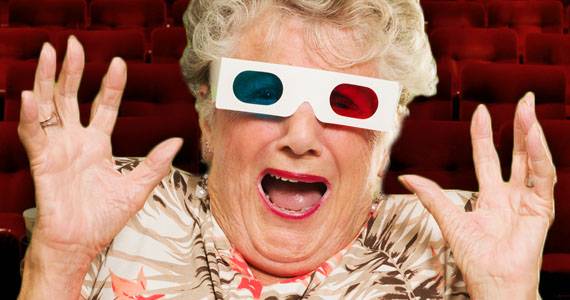
"Should I see it in 2D or pay the extra cost for 3D?"
It's a question that's being asked with increased frequency these days, as audiences are becoming more savvy about the 3D moviegoing experience. We've all been burned (one time or another) by a subpar post-conversion, distracting pop-out gimmicks, or underwhelming return on a pricey 3D investment. For this reason, it's easy to understand why so many film fans (and now, TV viewers) actively dismiss 3D as a shameful fad that handcuffs filmmakers - and subsequently, ruins most moviegoing experiences.
Yet, over the last five years we've also seen a number of captivating and memorable implementations of the format, including Avatar, Hugo, and Life of Pi, among others. Quality 3D wasn't limited to sci-fi or adventure films either - as Final Destination 5 and Dredd both delivered memorable (albeit tongue-in-cheek) use of 3D.
Of course, for every movie that is celebrated for its use of 3D, there's a vocal group of dissenters who disagree - for entirely valid reasons: uncomfortable eyewear, strained or disorienting visuals, and questions of creative control, among countless others. However, that doesn't mean that there isn't a lot of misinformation still out there about the format. 3D technology is evolving rapidly - and while we entirely support a viewer's right to boycott 3D (and sympathize with the estimated 10 percent of our population that can't even see 3D films), it's time to set the record straight by addressing what we believe are the 5 biggest misconceptions about 3D.
-

1. 3D Is Just A "Fad"
For years, 3D has been referred to as a "fad," but year after year we've seen an increasing number of 3D films in production - and behind-the-scenes technology is the biggest indicator that 3D filmmaking is here to stay. Gone are the days of Anaglyph 3D - when filmmakers rarely fine-tuned stereoscopic images before sending them off to blue-and-red glasses-wearing viewers.
These days 3D is an enormous industry - with countless companies dedicated to the format at every stage of development. Engineers push innovation in a number of areas: increasingly smaller and more user-friendly 3D cameras for filming; upcoming laser projectors capable of a brighter image and longer bulb-life in theaters; 4K TV sets that do away with battery-powered "active" shutter glasses and only require inexpensive "passive" 3D eyewear for home use.
Many of these technologies were extremely expensive one year ago and are significantly less expensive today - meaning that two years from now they'll be relatively inexpensive (a blink of the eye for hundred-year-old movie studios). Not to mention, non-entertainment-related 3D is a rapidly growing business - especially in the medical field where, for example, three-dimensional displays are already being used to save lives in operating rooms around the world.
As movie fans, we bounce around week-to-week from one film to the next - debating the quality of 3D. Yet, even when 3D has a bad week or month in theaters, the industry is designed for longterm viability. If cinephiles intend to boycott studios and wait for the "fad" to pass, they may never get off the sidelines.
———
-

2. Filmmakers Hate 3D, Too
While it's true that some filmmakers hate 3D, many do not - and have embraced the format. Some who used to hate 3D have come to appreciate its use - when it allows for a more immersive or memorable experience with their film.
It's no secret that studios are encouraging (and in some cases mandating) directors make movies in 3D, but let's not pretend that this is anything new in Hollywood. Filmmakers are subject to tremendous influence from producers and studio executives when it comes to project decisions. Creative preferences regularly bend for business reasons in casting, screenwriting, and editing, among other areas. Studio meddling can result in bad movies just as it can result in bad 3D. But that doesn't mean that every single director that's encouraged to use 3D is doomed to fail.
The biggest hurdle that 3D faced with directors (in both movies and television) was that the camera rigs and post-production work would get in the way of producing a quality piece of cinema. However, modern 3D camera setups are relatively compact and easy to use - meaning that in many cases 3D won't hinder directors, camera men, cinematographers, or anyone who would otherwise be responsible for shooting a 2D project. As a result, for interested filmmakers, 3D becomes another tool that they can use to draw viewers into their story.
Of course, unlike lighting or costume design, the 3D "tool" translates into a higher price point for consumers - and directors have to make sure their use of the tool ultimately delivers a worthwhile return on viewer investment.
Don't believe that 3D filming can be done at the same speed and quality of a 2D production? Check out Sony's 3D on a 2D Production Test.
———
NEXT: What Makes 3D Worthwhile?
-

3. "Subtle" 3D Isn't Worth the Extra Money
Consumers remain split on what constitutes quality 3D - with many claiming that subtle use of the format isn't worth the upgraded ticket price. Yet, taste in 3D is subjective - making it extremely difficult to measure "good" versus "bad" 3D. As a result, many viewers have turned to the fallible "Glasses Off" test to self-determine how much of the onscreen projection is distorted at any given moment. Previously, we clarified why this "Glasses Off" test isn't a good metric for determining 3D quality - since filmmakers often adjust the strength of the 3D effect in every single shot: backing off during intimate drama scenes and ramping up in large-scale action set pieces, for example.
Similarly, some of the more celebrated examples of 3D filmmaking rely on subtle use of the format. Fans of Martin Scorsese's Hugo claim the effect helped draw them into the film, whereas detractors maintain the director's use of the effect wasn't noticeable - and, therefore, not worth the added ticket price. This dichotomy places 3D in an tricky gray area, since filmmakers have to find a balance between making 3D worth the money, without allowing the effect to distract from onscreen tension and emotional drama - or even worse, making it uncomfortable to watch.
Since 3D films have long relied on "pop-out" effects, it's not surprising (or unfair) that some moviegoers aren't interested in more subtle implementations of the format. However, that doesn't mean that subtle use of 3D can't also be worth the added ticket price: Ang Lee's Life of Pi rarely used pop-out effects, but managed to deliver a rich visual experience that, for many moviegoers, successfully enhanced the impact of Pi's adventure at sea.
Like anything in this industry, 3D preference is personal and there's room for many types of experiences.
———
-

4. "Gimmicky" 3D is Bad
Most filmmakers maintain that 3D should serve the film's story - resulting in the subtle use of 3D discussed in the last section. But what if your story is a tongue-in-cheek comedic misadventure or balls-to-the-wall action flick - i.e., a film that is fundamentally designed from the ground up to avoid subtlety? Answer: forget subtlety and have fun.
Many cinephiles are quick to dismiss in-your-face 3D as a shallow gimmick, but moviegoers have also championed plenty of theater experiences where 3D was intentionally not-so-subtle. In fact, toying with audience 3D expectations often delivers a smart riff on established gimmicks - such as a death scene in Final Destination 5 involving a sailing mast. 3D filmmaking has been around for a long time, but as it becomes more and more prevalent (see question #1), it's encouraging to think that directors will find fresh ways to tweak the formula in order to surprise audiences. Of course, less-subtle uses of 3D can be disorienting (even nauseating) to watch - and going forward, filmmakers have a responsibility to ensure that more aggressive 3D isn't just entertaining, it's comfortable on the eyes.
Like "subtle" 3D, "gimmicky" 3D isn't going to be tasteful to every single filmgoer. There is no one-size fits all, so defining pop-out 3D effects as "bad" isn't exactly an accurate conclusion, either. In-your-face effects are responsible for crowd-pleasing moments in well-received films like Fright Night, Dredd, and Piranha 3D, among others - not to mention documentaries like Born to Be Wild 3D as well as the growing trend of 3D concert movies.
Different 3D experiences - just like different film genres - can peacefully co-exist in theaters. If your taste is limited to one approach more than another, the best thing to do is keep informed regarding how 3D is used in each film.
———
NEXT: What About "Post-Converted" 3D?
-

5. "Post-Converted" 3D Is A Cash Grab
Moviegoers have valid reasons to be skeptical of 3D post-conversion. During the initial resurgence of 3D in theaters, film fans were subjected to a number of rushed 3D post-conversions with distracting visual problems and overly-obvious "ghosting" (double-images). Further compromising stereo conversion integrity, studios forced cheap post-production 3D onto several subpar films in the hopes that premium ticket revenue would be enough to help earn back lost profits.
However, that doesn't mean that quality post-conversion doesn't exist or that it can't come very close to native-shot 3D experiences. In fact, many films now utilize a combination of native and post-converted 3D before appearing on the big screen. The Avengers, John Carter, and portions of Transformers: Dark of the Moon were all post-converted into 3D. Unlike the notoriously bad eight-week process of converting Clash of the Titans, quality 3D post-conversion companies spend between four to six months converting a film - and over a year for older films getting a 3D re-release (Jurassic Park 3D for example).
Quality post-conversion is an extremely complicated process where large teams of 3D artists pour over each individual frame of a film - determining where to enhance the effect and where to back off, as well as adjusting the overall footage to make 3D viewing crisp and comfortable. In most cases, the companies meet with directors before and during post-conversion to ensure that their artists stay true to a filmmaker's original vision.
There are obvious benefits to shooting in 3D, but many upcoming films have scheduled post-conversions prior to even shooting in 2D. This means that directors and cinematographers can plan three-dimensional shots ahead of time, mindful of how their film will appear in 3D, even though they're using traditional 2D cameras. Upcoming films that were shot in 2D and will undergo post-conversion into 3D include: G.I. Joe: Retaliation, Iron Man 3, Star Trek Into Darkness, Man of Steel, and Thor: The Dark World.
Still unsure of how the post-conversion process works? Check out this clip of Attack of The Show visiting Stereo D.
———
-

The Debate Rages On...
Ultimately, viewers have plenty of valid reasons to avoid 3D, and there are a lot of wrinkles that still need to be ironed out - since, in addition to personal predispositions and creative control, 3D can outright alienate a significant chunk of the population who can't even see the effect. Yet, a lot of especially-vocal anti-3D crusaders are working with outdated information - and hopefully, this article helps clarify a few long-running misconceptions.
To be fair, it's a very complicated industry fueled by a mix of creative and business-minded individuals, quick-evolving technology and complex methodologies that are full of variations - all before the subsequent 3D footage ever gets presented to viewers with subjective tastes and differing preferences. Over the years, we've certainly learned more than a few ways that 3D filmmaking can go awry - delivering distracting and downright ugly results. Still, there isn't one single "right" way to approach or measure quality 3D. Native or post-converted, subtle or in-your-face, moviegoers are enjoying a wide variety of 3D offerings available in theaters (and at home).
Of course, not every 3D film is going to offer an experience that's worthy of premium ticket pricing - regardless of personal 3D taste. Make sure to stay informed about which 3D movies are worth your hard-earned cash by taking recommendations from people you trust, as well as reading professional reviews. Screen Rant reviewers view 3D-available releases in 3D - so check back regularly for which ones deliver on the added price!
What are your feelings on 3D? Share and discuss with us in the comments below.
[poll id="537"]
———
Follow me on Twitter @benkendrick for future editorials, reviews, as well as movie, TV, and gaming news.